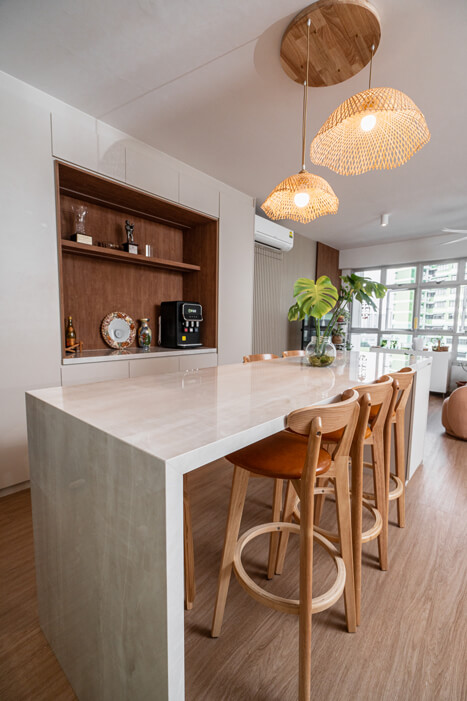
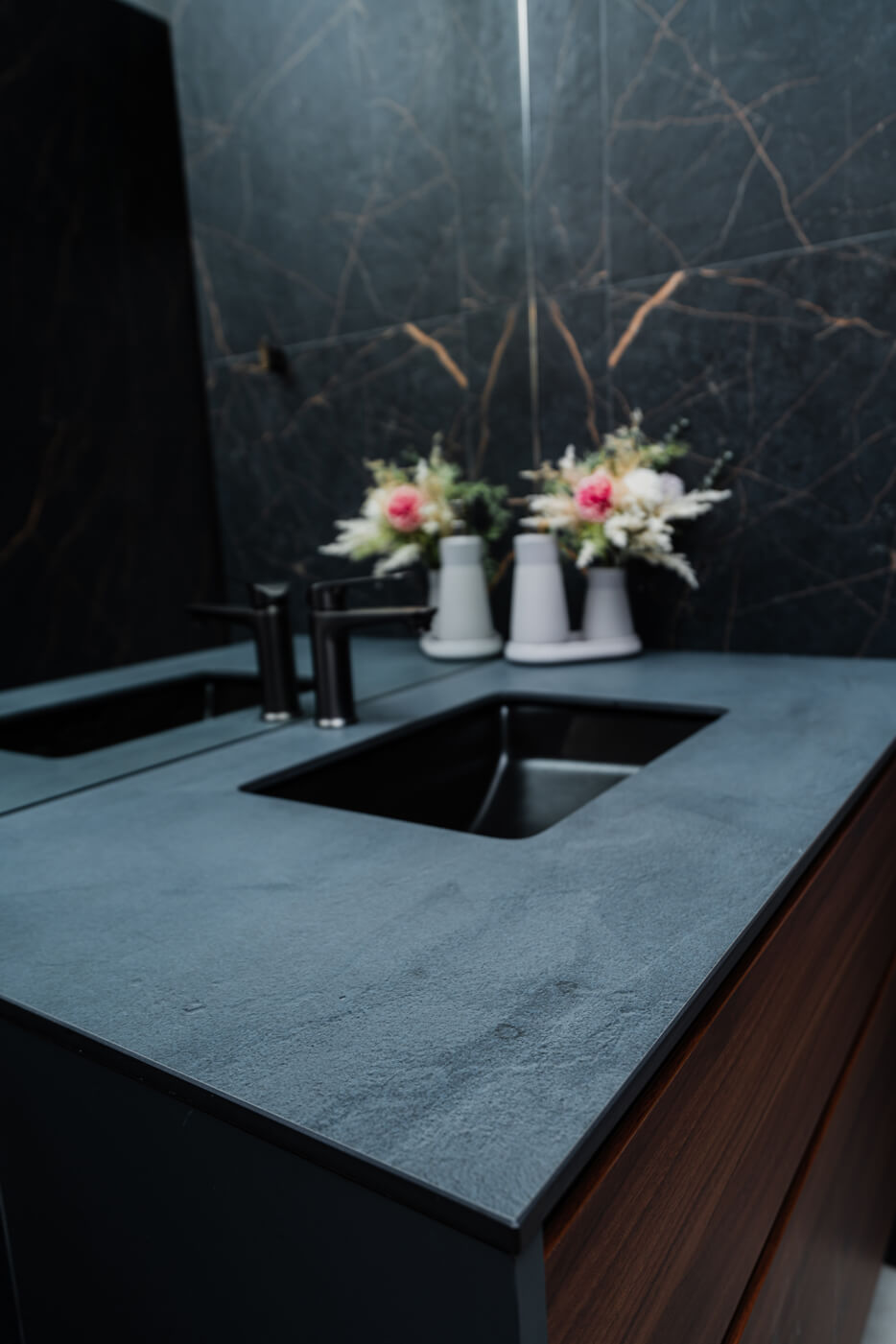
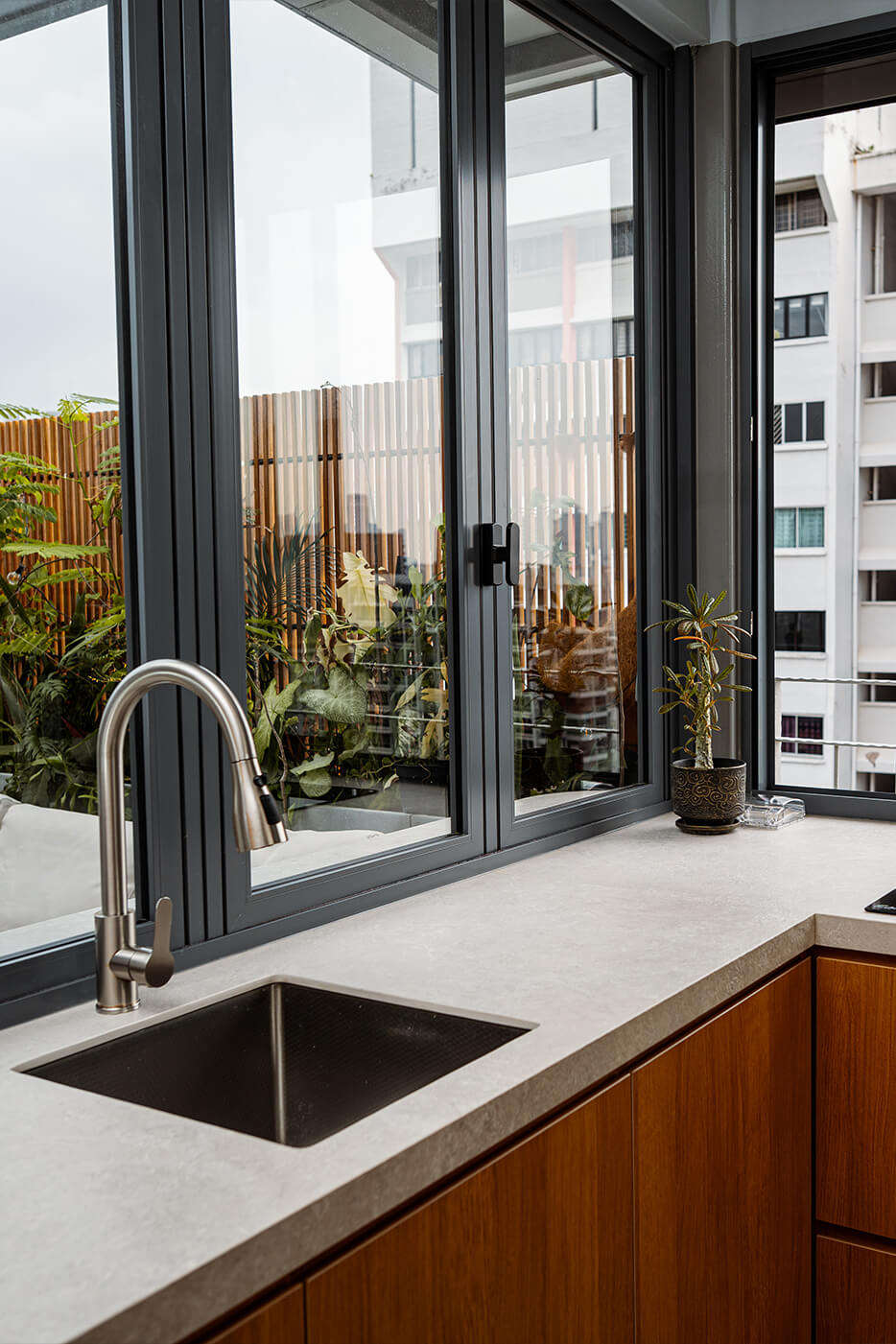
Advantages of Sintered Stone
1) It is a hygienic product
Sinetered stone slabs are ultra-compact, free of porosity and therefore antibacterial.
2) It is weatherproof
thermal excursions (frost, intense cold or high temperatures) and thermal shocks.
3) It is extremely high resistance to the scratches
once laid, the sintered stone will not be damaged easily. In the case of a kitchen worktop, for example, it can be cut, beaten or engraved directly on it.
4) It is resistant
to UV rays and any other natural and atmospheric agent.
5) It is fireproof
resistant to the most extreme heat and compactness is a guarantee of ultra-resistance over time.
6) It is easy to clean
You can wipe the surface easily with soap and water or a stone cleaner.
7) It is a sustainable material
100% biodegradable, free from heavy metals and chemical additives.
Sintered Stone vs Quartz
Similarities
1) Man made materials
Both engineered quartz and sintered stone materials are man made materials. Each has a variety of manufacturers that produce the materials. There are currently more producers of quartz than sintered stone. However, recently many of the companies that have been in the quartz industry for years produce Sintered Stone as it is the new generation product of high quality surfaces.
2) Hardness
Another area in which these materials are similar is the area of scratch resistance. Since both quartz and sintered stone are very hard, they both resist scratching that could occur as a result of normal household utensils. Even though sintered stone is somewhat harder, more resistant than quartz, either is acceptable as far as normal wear and tear is concerned.
3) Maintenance
The fact that neither sintered stone nor quartz needs to be sealed periodically, eliminates an entire aspect of maintenance that exists for natural stone surfaces. Because of this, both of these materials are considered easy to care for and maintain.
Differences
1) Composition
Sintered stone is made from a combination of raw materials that are combined. Each of the various manufacturers has its own recipe for its particular material, but they all begin with 100% natural raw materials.
Quartz is different. Although the raw material quartz is used in the production of quartz, there are also synthetic materials used to manufacture it. The quartz particles are combined with a binder (usually a polyester resin) and coloring pigment is added to create the specific colors.
2) Heat Resistance
Quartz can be susceptible to burning from high temperatures. This can happen in the fabrication shop or at home. If quartz is exposed to extreme heat, it can undergo discoloration because of the limits imposed by the resins in the material. Conversely, sintered stone is formed at very high temperatures and is therefore resistant to very high temperatures found in normal everyday household environments.
3) UV Resistance
Quartz is not UV resistant, so it is not recommended for use in outdoors. On the other hand, sintered stone is weatherproof and can be used as an outdoor material.
—————-
In conclusion, Sintered stone has better resistance to stains, impacts, heat and chemicals as compared to Quartz, Heat resistance is a particularly favourable characteristic as Quartz can have burn marks or change colour when subjected to heat.
Sintered Stone is an excellent option for outdoor projects as it is weatherproof and waterproof, whereas Quartz is not recommended for outdoor use.